
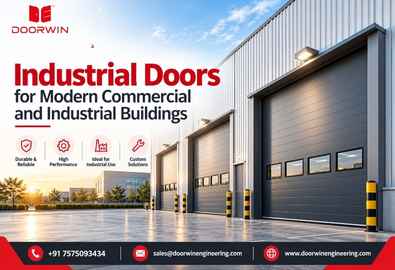
Industrial Doors for Modern Commercial and Industrial Buildings

Modern industries and commercial facilities require more than just functional entrances. Today, businesses need durable, secure, and efficient access solutions that improve safety, productivity, and operational performance. As industrial infrastructure continues to evolve, Industrial Doors have become an essential component of warehouses, manufacturing plants, logistics centers, commercial buildings, pharmaceutical facilities, food processing units, and large-scale industrial projects.

Industrial doors are specifically engineered to withstand demanding environments while providing reliable access control, enhanced security, and smooth operation. Moreover, they help businesses maintain workflow efficiency, protect valuable assets, and comply with industry safety standards.

Whether you are planning a new industrial facility or upgrading an existing building, choosing the right industrial door solution can significantly impact operational efficiency and long-term performance.

Why Industrial Doors Are Essential for Modern Facilities

Modern commercial and industrial buildings face unique operational challenges. Heavy machinery movement, high employee traffic, environmental exposure, and strict safety requirements demand specialized door systems that can perform consistently under pressure.

Unlike conventional doors, industrial doors are designed to handle frequent use, harsh weather conditions, and demanding industrial applications. Furthermore, they provide enhanced durability and improved security while reducing maintenance requirements.

Some of the key benefits include:

  • Improved workplace safety
  • Enhanced operational efficiency
  • Better security and access control
  • Increased energy efficiency
  • Reduced maintenance costs
  • Long service life
  • Compliance with industrial standards

As a result, businesses across various industries increasingly invest in high-quality industrial door systems to support their daily operations.

Types of Industrial Doors Used in Commercial and Industrial Buildings

Different industries require different door solutions. Therefore, understanding the available options helps organizations select the most suitable system.

01. Industrial Roller Shutter Doors

Industrial roller shutter doors are widely used in warehouses, logistics centers, factories, and distribution facilities.

Key Features

  • Compact design
  • Space-saving operation
  • High durability
  • Enhanced security
  • Easy maintenance

These doors operate vertically and require minimal overhead space. Consequently, they are ideal for facilities with limited space availability.

02. Sliding Industrial Doors

Sliding industrial doors are commonly installed in manufacturing plants, large storage facilities, and industrial complexes.

Benefits of Sliding Systems

  • Smooth operation
  • Large opening coverage
  • Excellent durability
  • Suitable for heavy-duty applications

Additionally, sliding doors offer reliable performance in facilities where large equipment and vehicles frequently move through access points.

03. Sectional Industrial Doors

Sectional doors consist of multiple panels connected through hinges and tracks.

Advantages of Sectional Doors

  • Excellent insulation
  • Enhanced security
  • Space-efficient design
  • Professional appearance

Because of their energy-saving capabilities, sectional doors are becoming increasingly popular in temperature-controlled environments.

04. High-Speed Industrial Doors

Modern industries prioritize efficiency and productivity. Therefore, high-speed industrial doors have gained significant popularity.

Applications of High-Speed Doors

  • Food processing facilities
  • Pharmaceutical plants
  • Clean rooms
  • Distribution centers
  • Cold storage facilities

These doors open and close rapidly, reducing energy loss and improving workflow efficiency.

Key Features of High-Quality Industrial Doors

Not all industrial doors offer the same level of performance. Businesses should evaluate several important factors before making a decision.

01. Strength and Structural Integrity

Industrial facilities often experience demanding operating conditions. Therefore, door systems must withstand continuous use and external impacts.

Strong industrial doors typically feature:

  • Heavy-duty steel construction
  • Reinforced frames
  • Corrosion-resistant materials
  • Robust hardware components

These features contribute to long-term reliability and reduced maintenance requirements.

02. Enhanced Security Protection

Security remains a major concern for industrial and commercial buildings.

Security Advantages

  • Controlled access
  • Theft prevention
  • Asset protection
  • Unauthorized entry restriction

By integrating advanced locking systems and reinforced structures, industrial doors provide an additional layer of facility protection.

03. Weather Resistance

Industrial buildings frequently face environmental challenges such as rain, wind, dust, humidity, and temperature fluctuations.

High-performance industrial doors are designed to resist:

  • Corrosion
  • Moisture damage
  • Dust infiltration
  • Extreme temperatures

As a result, they maintain operational efficiency throughout varying weather conditions.

04. Operational Efficiency

Efficient access systems directly influence productivity.

Performance Benefits

  • Faster opening cycles
  • Reduced downtime
  • Improved traffic flow
  • Better workflow management

Consequently, businesses can optimize daily operations while minimizing disruptions.

Industrial Doors and Workplace Safety

Workplace safety remains a top priority across all industries. Industrial doors play a critical role in maintaining a safe working environment.

01. Protecting Employees and Equipment

Industrial environments often involve:

  • Forklift operations
  • Heavy machinery movement
  • Continuous material handling
  • Large workforce activity

Properly designed industrial doors help separate operational zones, control movement, and reduce accident risks.

02. Fire Safety and Emergency Preparedness

Many industrial facilities integrate specialized door systems into their fire safety strategies.

Fire Safety Benefits

  • Compartmentalization
  • Emergency access support
  • Smoke control assistance
  • Regulatory compliance

When combined with broader fire protection measures, industrial doors contribute significantly to building safety.

03. Environmental Control

Certain industries require strict environmental management.

Examples include:

  • Pharmaceutical manufacturing
  • Food processing
  • Electronics production
  • Laboratory facilities

Industrial doors help maintain controlled conditions by reducing contamination risks and improving environmental separation.

How Industrial Doors Improve Business Productivity

Productivity is directly linked to operational efficiency. Industrial doors contribute to this objective in several important ways.

01. Faster Material Movement

Manufacturing facilities and warehouses depend on smooth logistics operations.

Industrial doors support:

  • Faster loading processes
  • Efficient unloading operations
  • Reduced transportation delays
  • Improved inventory movement

Consequently, organizations can achieve higher operational efficiency.

02. Reduced Energy Consumption

Energy costs continue to increase worldwide. Therefore, businesses actively seek ways to improve energy efficiency.

Energy-Saving Benefits

  • Better insulation
  • Reduced air leakage
  • Improved temperature control
  • Lower HVAC workload

As a result, industrial doors contribute to long-term operational savings.

03. Lower Maintenance Requirements

Durable industrial doors require fewer repairs and less downtime.

This results in:

  • Reduced maintenance expenses
  • Improved reliability
  • Greater operational continuity
  • Enhanced return on investment

Choosing the Right Industrial Doors for Your Facility

Selecting the right solution requires careful evaluation of operational requirements.

I. Assess Building Requirements

Before choosing a door system, businesses should consider:

  • Building size
  • Operational flow
  • Traffic volume
  • Environmental conditions
  • Security requirements

These factors help determine the most suitable door type.

II. Evaluate Material Quality

The quality of materials directly impacts performance and longevity.

Recommended Material Characteristics

  • Corrosion resistance
  • High structural strength
  • Impact resistance
  • Long service life

Choosing premium materials often leads to lower ownership costs over time.

III. Consider Future Expansion

Businesses should think beyond current needs.

Industrial doors that support future growth offer:

  • Greater flexibility
  • Better scalability
  • Long-term value
  • Improved facility planning

Therefore, organizations should select solutions capable of adapting to future operational demands.

Industries That Benefit from Industrial Doors

Industrial doors serve a wide range of sectors.

01. Manufacturing Industry

Manufacturing plants require reliable access systems that support production efficiency and workplace safety.

02. Warehousing and Logistics

Warehouses rely on industrial doors to facilitate smooth inventory movement and loading operations.

03. Pharmaceutical Facilities

Pharmaceutical environments demand controlled access and contamination prevention measures.

04. Food Processing Plants

Food processing facilities require hygienic and efficient door systems that support cleanliness standards.

05. Automotive Industry

Automotive manufacturing facilities depend on durable industrial doors capable of handling intensive daily operations.

06. Commercial Buildings

Large commercial properties use industrial doors to improve security, operational efficiency, and access management.

Future Trends in Industrial Doors

Industrial infrastructure continues to evolve alongside technological advancements.

01. Smart Automation

Automated industrial doors are becoming increasingly common.

Benefits include:

  • Remote operation
  • Access control integration
  • Real-time monitoring
  • Enhanced security

02. Energy-Efficient Designs

Manufacturers continue developing doors that improve insulation and reduce energy consumption.

03. Sustainable Manufacturing

Eco-friendly materials and sustainable production practices are becoming more important within the industrial sector.

Advanced Safety Technologies

Future industrial doors will incorporate:

  • Sensor systems
  • Collision detection
  • Automated emergency functions
  • Enhanced monitoring capabilities

These innovations will further improve safety and operational efficiency.

Frequently Asked Questions About Industrial Doors

Industrial Doors are designed for warehouses, factories, manufacturing plants, logistics centres, workshops, commercial buildings, loading areas, and other high-traffic facilities. They provide durable access while supporting safety, security, smooth movement, and efficient daily operations.

Was this helpful?
Common types include industrial steel doors, sliding doors, fire-rated doors, automatic doors, high-speed doors, sectional doors, and specialised doors for specific environments. The right type depends on the opening size, traffic level, security requirements, available space, and operating conditions.

Was this helpful?

Start by checking the opening dimensions, traffic frequency, available installation space, material movement, security needs, environmental conditions, and required safety features. A professional manufacturer can then recommend a suitable configuration based on your facility and workflow.

Was this helpful?

Yes. Industrial Doors are widely suitable for warehouses, factories, manufacturing units, logistics facilities, workshops, and production areas. They can support frequent movement of forklifts, machinery, vehicles, employees, and materials while providing reliable access and security.

Was this helpful?

The main benefits include improved workflow, stronger security, better space utilisation, reliable performance, controlled access, enhanced workplace safety, and long-term durability. The right system can also reduce operational interruptions in busy commercial and industrial facilities.

Was this helpful?

Yes. Industrial door systems can often be customised according to the required width, height, material, finish, operating method, hardware, and site conditions. Customisation is particularly useful for warehouses, factories, loading bays, and facilities with large or non-standard openings.

Was this helpful?

Yes. Depending on the application, businesses can choose manual or automated operation. Automatic systems can benefit high-traffic entrances because they allow controlled and convenient access while helping employees and equipment move through the opening efficiently.

Was this helpful?

They can help separate work zones, control vehicle and pedestrian access, secure restricted areas, and support safer material movement. Additional features such as suitable locking systems, safety sensors, vision panels, and emergency operation can be selected according to the application.

Was this helpful?

The service life depends on the door construction, usage frequency, installation quality, operating environment, and maintenance schedule. Regular inspection and preventive maintenance can help identify worn components early and support reliable long-term performance.

Was this helpful?

Businesses in Ahmedabad can work with an experienced industrial door manufacturer that offers suitable designs, customisation, professional installation, and after-sales support. Doorwin Engineering provides door solutions for commercial and industrial applications and can help customers select a system based on their project requirements.

Was this helpful?

Conclusion: Choosing the Right Industrial Doors for Your Facility

Choosing the right Industrial Doors solution is essential for modern commercial and industrial buildings. High-quality industrial doors improve security, enhance workplace safety, support operational efficiency, and contribute to long-term business success. Whether installed in manufacturing plants, warehouses, logistics centers, pharmaceutical facilities, or commercial properties, industrial doors provide reliable performance under demanding conditions.

As industries continue to modernize, investing in durable and efficient industrial doors becomes increasingly important. Businesses that prioritize quality, safety, and operational excellence can benefit from improved productivity, reduced maintenance costs, enhanced security, and greater long-term value. Doorwin Engineering provides industrial door solutions designed to meet the evolving needs of modern industries and commercial facilities. By selecting the right industrial door system, organizations can create safer, more efficient, and future-ready facilities.

Get Expert Industrial Doors for Your Project

    Industrial Doors for Modern Commercial and Industrial Buildings

    Comments are closed

    Inquiry Now
    ×

      error: Content is protected !!